Published benchmark results
These tables are generated from the raw JSON committed in benchmarks/. They are development
evidence for specific synthetic workloads, not a universal claim that Testenix is always faster
than pytest. Testenix in these results means the native testenix run engine. The
testenix pytest compatibility bridge delegates to pytest and is not represented here.
Testenix 0.3.0 scaling matrix
No current-version matrix is checked in yet. The historical results below must therefore not be
described as Testenix 0.3.0 performance. The new provenance-gated harness covers
100/500/1,000/3,000 tests, balanced/dominant/single-module layouts, 1/2/4/auto workers, and both
default history and --no-history, plus explicit safe-module sharding. Its default design uses
dimension sweeps; use
--full-cross-product only when the much larger run is intentional.
auto is passed literally to Testenix and remains adaptive; observed Testenix worker counts are
stored per sample. pytest-xdist resolves its side of an auto row separately to the machine’s
logical CPU count.
$ uv run --no-editable python benchmarks/run_scaling_matrix.py \
    --output benchmarks/scaling_matrix_0_3_0.json
The command refuses a dirty worktree or an installed Testenix version that differs from
pyproject.toml. --allow-dirty is available only for unpublished smoke runs. A matrix becomes
publishable here only after five measured rounds, one warm-up, clean commit provenance, and full
axis coverage pass the documentation generator’s validation.
Real-project harness
The 118-test project used during v0.2 migration validation was a semantic parity gate, not a publishable benchmark: its release-note timings were single observations without a committed multi-round record. Use the redaction-safe manifest harness for a real repository:
$ cp benchmarks/real_project_manifest.example.json /tmp/testenix-project-benchmark.json
$ uv run --no-editable python benchmarks/run_project_benchmark.py \
    --project /absolute/path/to/project \
    --manifest /tmp/testenix-project-benchmark.json \
    --output /tmp/testenix-project-result.json
The manifest stores argument arrays, never shell fragments. The result omits stdout, stderr,
environment values, absolute project paths, and private source. It records only timings, aggregate
output sizes, optional tree fingerprints, and redacted Git provenance. A migrated-suite comparison
must point the manifest at a successful migration report to become publication-eligible. The
harness verifies the report’s exact per-test inventory and outcomes, complete source and generated
Python-file inventories, current hashes, and binds canonical python -m pytest /
python -m testenix run commands to the report’s source/output roots. Publishable source roots are
directories so support files such as conftest.py are covered. Without the report the result is
diagnostic-only. Commands are retained for
reproducibility. Publishable commands put options before -- and exact suite targets after it, so
an option value cannot impersonate a migration root. Keep secrets in the environment or list
sensitive argument indexes in redact_arguments.
Historical Testenix 0.1.0 synthetic baseline
The checked-in 3.15× figure is a Testenix 0.1.0 result for 100,000 generated no-op
tests across 16 modules, four workers, disabled history (--no-history), and pytest-xdist’s default
load strategy. It is retained as transparent historical evidence; it is not a measurement of
Testenix 0.3.0.
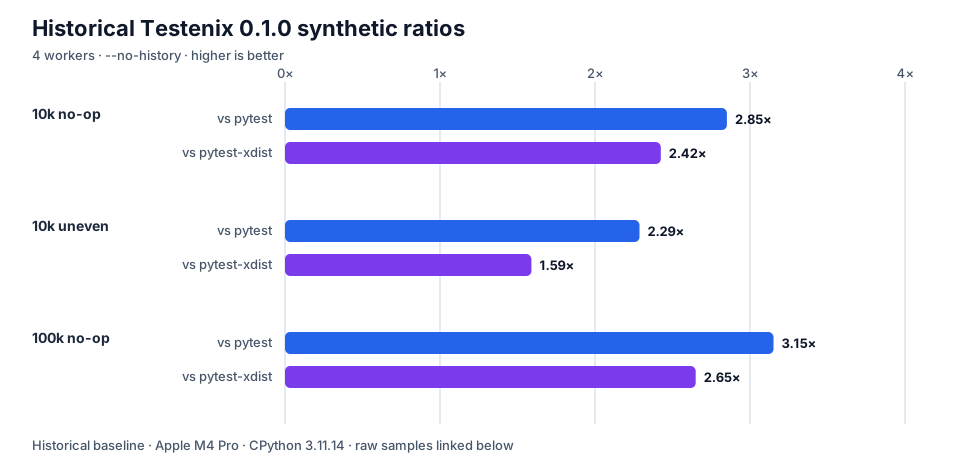
Median wall-clock time
Lower time is better. A speedup of 2.85× means pytest’s median
wall time was 2.85 times the Testenix median for that exact
scenario.
Scenario |
Testenix |
pytest |
pytest-xdist |
vs pytest |
vs xdist |
|---|---|---|---|---|---|
10,000 no-op tests / 16 modules |
0.869 s |
2.477 s |
2.106 s |
2.85× |
2.42× |
10,000 uneven-duration tests / 16 modules |
1.345 s |
3.076 s |
2.138 s |
2.29× |
1.59× |
100,000 no-op tests / 16 modules |
8.038 s |
25.333 s |
21.300 s |
3.15× |
2.65× |
Environment and controls
CPU: Apple M4 Pro (14 logical CPUs)
Machine:
arm64Platform:
macOS-26.5.1-arm64-arm-64bitPython:
3.11.14Testenix:
0.1.0Workers: four for Testenix and pytest-xdist
Testenix history: disabled with
--no-historypytest-xdist: version
3.8.0, defaultloaddistributionMeasurement: complete subprocess wall-clock time, including discovery, execution, aggregation, and console rendering
Correctness gate: every command had to exit successfully and report the expected test count
Raw samples and variance
10,000 no-op tests / 16 modules
Testenix range: 0.857 s–0.892 s
Testenix standard deviation: 0.013 s
Testenix raw samples: 0.869, 0.857, 0.863, 0.892, 0.871 seconds
pytest range: 2.447 s–2.522 s
pytest standard deviation: 0.027 s
pytest raw samples: 2.522, 2.477, 2.471, 2.447, 2.479 seconds
pytest-xdist range: 2.075 s–2.267 s
pytest-xdist standard deviation: 0.081 s
pytest-xdist raw samples: 2.170, 2.267, 2.077, 2.075, 2.106 seconds
Measured rounds: 5; warmups: 1
Workers: 4
Testenix history: disabled with
--no-historypytest-xdist strategy: default
loadRecorded at:
2026-07-20T12:12:43.635798+00:00Commit:
8f24f8a7bd72fa876988a8ce96364be97e35c2b6Clean working tree at capture: yes
10,000 uneven-duration tests / 16 modules
Testenix range: 1.336 s–1.378 s
Testenix standard deviation: 0.016 s
Testenix raw samples: 1.336, 1.378, 1.342, 1.345, 1.356 seconds
pytest range: 3.043 s–3.085 s
pytest standard deviation: 0.016 s
pytest raw samples: 3.070, 3.085, 3.043, 3.076, 3.077 seconds
pytest-xdist range: 2.109 s–2.176 s
pytest-xdist standard deviation: 0.025 s
pytest-xdist raw samples: 2.146, 2.129, 2.109, 2.138, 2.176 seconds
Measured rounds: 5; warmups: 1
Workers: 4
Testenix history: disabled with
--no-historypytest-xdist strategy: default
loadRecorded at:
2026-07-20T12:13:53.369799+00:00Commit:
18d9bba6cb5c8e39c2d5b211ee4384ae8f824524Clean working tree at capture: yes
100,000 no-op tests / 16 modules
Testenix range: 7.912 s–8.096 s
Testenix standard deviation: 0.075 s
Testenix raw samples: 7.912, 8.096, 8.086, 8.038, 7.997 seconds
pytest range: 25.188 s–27.005 s
pytest standard deviation: 0.772 s
pytest raw samples: 27.005, 25.333, 25.246, 25.188, 25.380 seconds
pytest-xdist range: 21.120 s–22.216 s
pytest-xdist standard deviation: 0.486 s
pytest-xdist raw samples: 21.239, 21.120, 22.216, 21.300, 21.949 seconds
Measured rounds: 5; warmups: 1
Workers: 4
Testenix history: disabled with
--no-historypytest-xdist strategy: default
loadRecorded at:
2026-07-20T12:19:39.942492+00:00Commit:
24b877c2f98420e91dcd2c8bcbc9417c7cf1ac96Clean working tree at capture: yes
Migrated-suite measurements
These separate measurements start with generated pytest or unittest sources, complete one safe
copy-and-validate migration, and then compare recurring source-suite runs with recurring native
Testenix runs. The migration transaction is a one-time cost shown separately; it is not included
in either execution median. These records came from the pre-v0.2 source commit linked below; its
distribution metadata still reported 0.1.0. They are historical evidence, not measurements of
the current release.
Source runner |
Workload |
Tests / modules |
Source median |
Native median |
Native vs source |
Migration transaction |
|---|---|---|---|---|---|---|
pytest (sequential) |
no-op |
3,000 / 64 |
1.539 s |
0.521 s |
2.96× faster |
5.940 s |
unittest outcome probe (sequential) |
no-op |
3,000 / 64 |
0.161 s |
1.192 s |
7.40× slower |
6.742 s |
unittest outcome probe (sequential) |
1 ms body |
3,000 / 64 |
4.066 s |
2.577 s |
1.58× faster |
17.251 s |
The native side used four workers. The source pytest and unittest outcome-probe baselines were sequential, so these rows do not compare Testenix with pytest-xdist or another parallel unittest runner. The unittest probe uses the standard-library loader and result semantics, then serializes per-test outcomes for parity checking; its timing therefore includes that small audit overhead. The no-op unittest wrappers are 7.40× slower than the probe because wrapper, loading, and result-adaptation costs dominate an empty body. With 1 ms of synthetic work per unittest method, parallel native execution is 1.58× faster in this 64-module layout. Module count and duration are therefore material, and none of these synthetic rows predicts a specific real project.
Raw migration samples and variance
pytest / no-op
Source command:
python -m pytest -q -p no:cacheprovider testsNative command:
python -m testenix run testenix_migrated --workers 4 --no-historySource median: 1.539 s
Source range: 1.519 s–1.573 s; standard deviation: 0.020 s
Source raw samples: 1.547, 1.535, 1.539, 1.573, 1.519 seconds
Native Testenix median: 0.521 s
Native Testenix range: 0.496 s–0.570 s; standard deviation: 0.030 s
Native Testenix raw samples: 0.532, 0.498, 0.570, 0.496, 0.521 seconds
Native workers: 4
Measured rounds: 5; warmups: 1
One-time copy, validation, and publication transaction: 5.940 s
Integrity gates: 3,000 converted tests, matching source/native outcomes, original SHA-256 values unchanged
Recorded at:
2026-07-20T16:38:49.510465+00:00Source commit:
3a51a901d268b061e9a87168300b41f3a2714a84; worktree cleanLock SHA-256:
8ef0a9258aa5196bf2891f9da9f66c29bcf4e9bf297d178f3d4939cad36130cfVersions: pytest=9.1.1, python=3.11.14, testenix=0.1.0, unittest=stdlib-3.11.14
Environment: cpu_count=14, cpu_model=Apple M4 Pro, machine=arm64, platform=macOS-26.5.1-arm64-arm-64bit, python_implementation=CPython, python_version=3.11.14
unittest / no-op
Source command:
python -m testenix._unittest_probe --output <project>/.benchmark-unittest.json testsNative command:
python -m testenix run testenix_migrated --workers 4 --no-historySource median: 0.161 s
Source range: 0.154 s–0.166 s; standard deviation: 0.004 s
Source raw samples: 0.161, 0.160, 0.161, 0.154, 0.166 seconds
Native Testenix median: 1.192 s
Native Testenix range: 1.151 s–1.264 s; standard deviation: 0.051 s
Native Testenix raw samples: 1.192, 1.171, 1.256, 1.151, 1.264 seconds
Native workers: 4
Measured rounds: 5; warmups: 1
One-time copy, validation, and publication transaction: 6.742 s
Integrity gates: 3,000 converted tests, matching source/native outcomes, original SHA-256 values unchanged
Recorded at:
2026-07-20T16:39:05.030979+00:00Source commit:
3a51a901d268b061e9a87168300b41f3a2714a84; worktree cleanLock SHA-256:
8ef0a9258aa5196bf2891f9da9f66c29bcf4e9bf297d178f3d4939cad36130cfVersions: pytest=9.1.1, python=3.11.14, testenix=0.1.0, unittest=stdlib-3.11.14
Environment: cpu_count=14, cpu_model=Apple M4 Pro, machine=arm64, platform=macOS-26.5.1-arm64-arm-64bit, python_implementation=CPython, python_version=3.11.14
unittest / 1 ms body
Source command:
python -m testenix._unittest_probe --output <project>/.benchmark-unittest.json testsNative command:
python -m testenix run testenix_migrated --workers 4 --no-historySource median: 4.066 s
Source range: 4.023 s–4.075 s; standard deviation: 0.021 s
Source raw samples: 4.075, 4.063, 4.066, 4.023, 4.067 seconds
Native Testenix median: 2.577 s
Native Testenix range: 2.454 s–2.644 s; standard deviation: 0.071 s
Native Testenix raw samples: 2.577, 2.601, 2.571, 2.454, 2.644 seconds
Native workers: 4
Measured rounds: 5; warmups: 1
One-time copy, validation, and publication transaction: 17.251 s
Integrity gates: 3,000 converted tests, matching source/native outcomes, original SHA-256 values unchanged
Recorded at:
2026-07-20T16:40:02.708652+00:00Source commit:
3a51a901d268b061e9a87168300b41f3a2714a84; worktree cleanLock SHA-256:
8ef0a9258aa5196bf2891f9da9f66c29bcf4e9bf297d178f3d4939cad36130cfVersions: pytest=9.1.1, python=3.11.14, testenix=0.1.0, unittest=stdlib-3.11.14
Environment: cpu_count=14, cpu_model=Apple M4 Pro, machine=arm64, platform=macOS-26.5.1-arm64-arm-64bit, python_implementation=CPython, python_version=3.11.14
Interpretation
The historical checked-in results show that Testenix 0.1.0 had low per-test overhead for the large
generated suites above and was competitive with sequential pytest and pytest-xdist’s default
load strategy in those scenarios. They are not evidence for the current release.
They do not yet answer how Testenix performs for import-heavy applications, complex fixture graphs, assertion failures, real repositories, or different operating systems. Pytest also has a far larger plugin and tooling ecosystem. Read the full performance analysis for profiling details, memory notes, implemented optimizations, and the Rust/PyO3 decision.
Reproduce
Run the same harness from a locked development environment:
$ uv sync --locked --dev --no-editable
$ uv run python benchmarks/run_benchmark.py --tests 10000 --workers 4 --repeats 5
$ uv run python benchmarks/run_benchmark.py --tests 10000 --workers 4 --repeats 5 --uneven
$ uv run python benchmarks/run_benchmark.py --tests 100000 --workers 4 --repeats 5
$ uv run python benchmarks/run_migration_benchmark.py --framework pytest --tests 3000 \
    --modules 64 --workers 4 --warmups 1 --repeats 5 \
    --output benchmarks/migration_baseline_pytest_3000.json
$ uv run python benchmarks/run_migration_benchmark.py --framework unittest --tests 3000 \
    --modules 64 --workers 4 --warmups 1 --repeats 5 \
    --output benchmarks/migration_baseline_unittest_3000.json
$ uv run python benchmarks/run_migration_benchmark.py --framework unittest --tests 3000 \
    --modules 64 --workers 4 --delay-ms 1 --warmups 1 --repeats 5 \
    --output benchmarks/migration_baseline_unittest_3000_delay_1ms.json
Review the benchmarking contract before comparing or publishing new data.